

Channel Catfish
Channel Catfish Flavor Profile
Channel Catfish have a distinctive taste; moist, sweet and mild flavored with firm flesh which has less flake than other whitefish. They are considered the best eating catfish in North America. Most commercial catfish in the United States are farmed Channel Catfish, and unlike most fish, farmed catfish are preferred over wild because aquaculture raised catfish have a more consistent flavor and does not have a muddy taste. They are FDA regulated and fed a diet of grain. Since they do not have scales Catfish are not kosher.
Basa (Vietnamese catfish) has a milder flavor and a more delicate texture which may be more approachable for people who do not care for catfish. Swai have a coarser texture than Channel Catfish & Basa, with tan to beige colored flesh which cooks up white.
Catfish Flavor Scale
| Flavor | |||||||
| Oil | |||||||
| Texture | |||||||
Typical Cooking Methods
Purchasing Guidelines
The meat of fresh catfish is white to off-white with pinkish hues, an iridescent sheen and noticeable translucence. Avoid fillets that are reddish or yellowish. After cooking the flesh is white and opaque. The quality of catfish is dependent upon the water conditions and feed. Watch out for "specials" which may feature the less-desirable and often muddy tasting wild river catfish. Do not confuse ocean catfish (wolfish) with farmed channel catfish.
Alternate Names
Spotted Catfish, Willow Catfish, Fiddler, Forked-tail Catfish
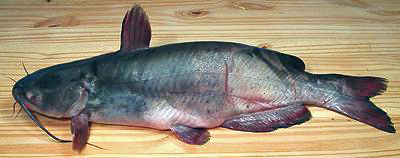
Channel Catfish Description (Ictalurus puncatus)
Channel Catfish have a rather flattened head with barbels resembling cat whiskers and deeply forked tails. They have no scales (although some species do have overlapping armor plates) but are covered with a slippery protective mucus. They are usually bluish olive, black or gray on the upper part of the body, usually with dark spots flecked on their sides, with to color fading to white on the belly. The skin is tough and is generally not eaten.
Average market weight of Channel Catfish is 1 to 1 ½ pounds but can grow to 57 pounds.
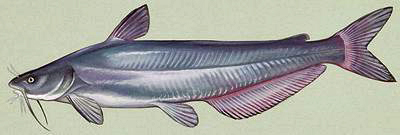
Blue Catfish Description (Ictalurus furcatus)
Blue Catfish appear very similar to Channel Catfish and are also raised by aquaculture, but not to the extent that Channel Catfish are.
Fresh Availability
Fresh seafood availability chart: green areas show peak availability, light green show limited availability, gray indicates not available fresh. Frozen product is available all year long.
| Jan | Feb | Mar | Apr | May | June | July | Aug | Sept | Oct | Nov | Dec | ||||||||||||||||||||||||||||||||||||
|---|---|---|---|---|---|---|---|---|---|---|---|---|---|---|---|---|---|---|---|---|---|---|---|---|---|---|---|---|---|---|---|---|---|---|---|---|---|---|---|---|---|---|---|---|---|---|---|
Channel Catfish Butchering Yield Percentage and Recovery
| Item | To Skin/On Fillets | To Skin/Off Fillets | To Skirt/Off, Skin/Off |
|---|---|---|---|
| Whole Head/On gutted, 4 lb – up | 63% | 50% | 42% |
| Whole Head/On gutted, 2 lb – down | 60% | 40% | skirt is too thin |
| Skin/On Fillets | — | 87% | 67% |
Range & Habitat
Channel Catfish is the most farmed fish in North America, mostly in the South, especially Mississippi. Wild Channel and Blue Catfish are native to North America and range from the central drainages of the Mississippi River from southern Canada to northern Mexico.
Typical Wholesale Products
Catfish is available Whole, H & G, Fillets (Skn/Off), Steaks, Strips, Nuggets.
Catfish Sustainability Information
| Name | Alternate Names | Catch Method | Where Caught | Seafood Watch | Ocean Wise | Sea Choice | Mercury Concerns |
|---|---|---|---|---|---|---|---|
| Catfish | Channel Catfish | Farmed, closed system | US |  |
|
|
low |
= Best Choice/Recommended
 = Good Alternative = Good Alternative
 = Avoid/Not Recommended Updated July 2013 = Avoid/Not Recommended Updated July 2013
|
|||||||
Nutritional Information
based upon a 6 oz (171 grams) raw edible serving.
| * Calories/Calories from fat | 231 |
| * Protein grams | 27 |
| * Fat grams | 13 |
| * Saturated fat grams | 3 |
| * Sodium milligrams | 91 |
| * Cholesterol milligrams | 81 |
| * Omega-3 grams | .7 |