

Sockeye Salmon
Wild Sockeye Salmon Flavor Profile
Fresh wild Sockeye Salmon has the firmest, reddest flesh of all wild Pacific salmon and is my personal favorite. It is a delicious, full-flavored fish which lends itself to a wide variety of cooking applications. In the Pacific Northwest we look forward to each new Sockeye Salmon season which starts in mid May with the opening of Copper River Salmon. It is considered the most valuable of US salmon species and much of it is shipped to Japan where it is relished. The name “Sockeye” is a butchered pronunciation of the Native American name “Sukkai”.
texture with medium sized flakes and flesh which ranges in color from orange to deep red. Compared to Chinook (King) Salmon, Sockeye has a denser, meatier texture and a more intense flavor, while King has a more succulent, tender texture with larger flakes.
Sockeye Salmon Flavor Scale
| Flavor | |||||||
| Oil | |||||||
| Texture | |||||||
Typical Cooking Methods
Sushi Health Code Notes for Salmon
These are notes from the Washington State Health Code, the health codes in your region may be different.
Wild salmon for sushi should be frozen following these guidelines to kill any potential
parasitic larvae:
- frozen and stored at -20° F (-29° C) for a minimum of 7 days (168 hours), or
- frozen at or below -31° F (-35° C) until solid and then stored at that temp for a minimum of 15 hours, or
- frozen at or below -31° F (-35° C) until solid then stored at -20° F (-4° C) for a minimum of 24 hours
Aquacultured salmon for sushi can be served fresh (never frozen) under the following circumstances:
- they are raised in open-water net-pens, or
- are raised in laned-based systems such as ponds or tanks
- and are fed a formulated feed (such as pellets) which contains no live parasites. This means they are NOT fed live fish, or fresh fishmeal and/or algae.
- (I don’t quite understand these distinctions for aquacultured fish as it seems to allow virtually all aquacultured fish! Very minimal standards. Apparently, the parasite issue is much more prevalent among wild fish.)
Proper documentation for sushi products
- If freezing the fish in-house, documentation must show the temperatures and time held at each temperature for all product
- If frozen product is purchased from a vendor then supporting documentation from the vendor is required stating temperatures and time held at each temperature for all product
- Fresh aquacultured fish must have supporting documentation from the vendor stating the fish was cultivated according to the standards stated above.
- All documentation must be kept for 90 days
Alternate Names
Blueback, Red Salmon, Kokanee Salmon if it is landlocked, Quinault, Jack Salmon (they return to the river earlier than expected and are usually males).
Sockeye Salmon Description(Oncorhynchus nerka)
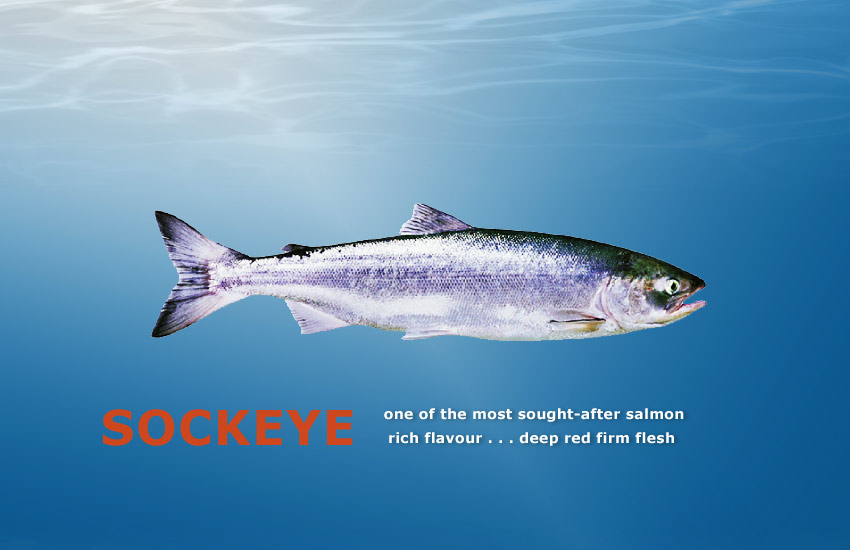
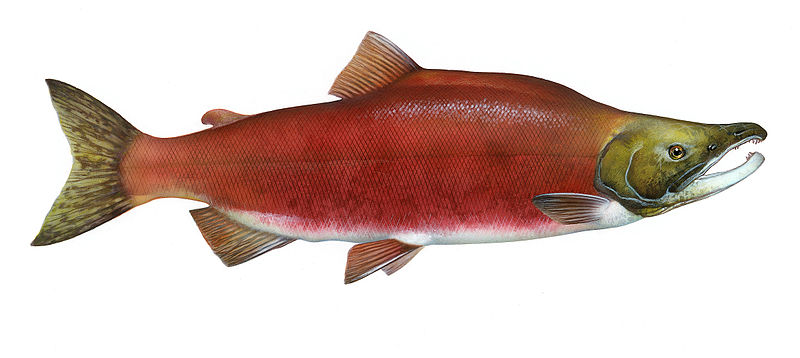
Sockeye change color as they migrate from saltwater to fresh water. In saltwater they are blueish-green on their top half and silvery on the bottom with a light speckling of spots on the back and tail. In fresh water they have a light green head and bright red bodies. Sockeye Salmon can be up to 33″ long and weigh up to 16 lbs but average around 6-8 lbs. They have an average life span of about 5 years, and all sockeye die within a few weeks of spawning.
Fresh Wild Sockeye Salmon Availability
The chart below shows the annual availability of fresh wild Sockeye Salmon: green areas show peak availability, light green show limited availability, gray indicates not available fresh. Frozen available all year long.
| Jan | Feb | Mar | Apr | May | June | July | Aug | Sept | Oct | Nov | Dec | ||||||||||||||||||||||||||||||||||||
|---|---|---|---|---|---|---|---|---|---|---|---|---|---|---|---|---|---|---|---|---|---|---|---|---|---|---|---|---|---|---|---|---|---|---|---|---|---|---|---|---|---|---|---|---|---|---|---|
Sockeye Salmon Butchering Yield Percentage and Recovery
| Item | To Skin/On Fillets | To Skin/Off Fillets | Notes |
|---|---|---|---|
| Whole Head/On gutted | 57% | 50% | |
| Head/Off gutted | 72% | 62% | |
| Skin/On Fillets | — | 87% | If you have additional yield info on this fish please leave a comment below. |
| Yield % varies according to a number of factors including: size of fish, season, sex, and the skill of your fishmonger. | |||
How to Fillet Sockeye Salmon Video
Fishmonger’s demo on how to break-down a whole salmon. This is a training demo, taking things slow and showing some of the specific angles and techniques to get the most meat out of the fish.
Range & Habitat
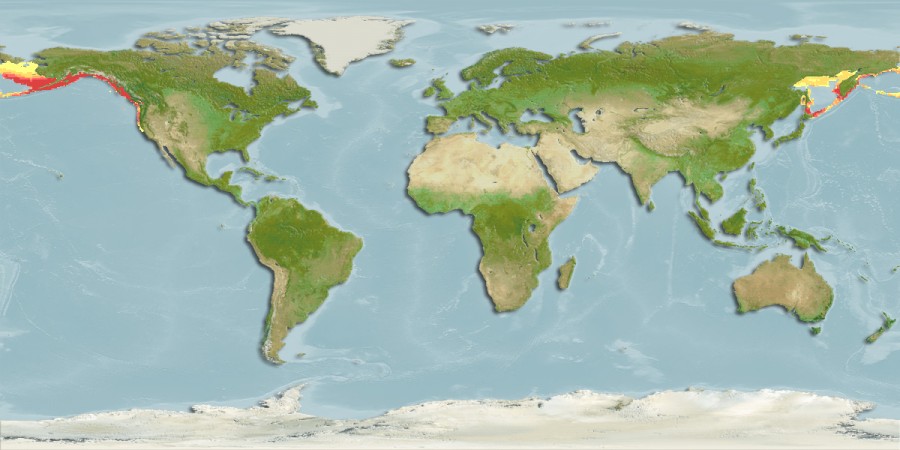
Sockeye Salmon inhabit the North Pacific from: northern Japan to the Bering Sea and to Los Angeles, California, USA. Landlocked populations in Alaska, Yukon Territory and British Columbia in Canada, and Washington and Oregon in USA.
Typical Wholesale Products
Whole Head/On gutted, Whole Head/Off gutted, Filets, Steaks
Sockeye Salmon Sustainability Info
| Name | Alternate Names | Catch Method | Catch Region |
Seafood Watch |
Ocean Wise |
Sea Choice |
Mercury Concerns |
|---|---|---|---|---|---|---|---|
| Sockeye | Blueback, Red Salmon, Kokanee | Wild – Drift Gillnet, Purse Seine, Troll | US – Alaska |  |
|
|
Low |
| US – CA, OR, WA |  |

|
|
||||
| Canada | |
|
|||||
| Reefnet – early summer run | WA – Lummi & San Juan Islands | |
n/a | |
|||
| Reefnet – late summer/fall runs | |
n/a | |
||||
| Farmed – Closed System | US | n/a | |
n/a | |||
| Roe | Ikura | Wild – Drift Gillnet, Purse Seine, Troll | US – Alaska | |
n/a | |
Low |
| Canada | n/a | n/a | |
||||
| Disclaimer: The sustainability info above is accurate to the best of our knowledge. However, each program randomly updates their information without our knowledge. We therefore recommend that you verify the current accuracy of this information. | |||||||
|
= Best
Choice/Recommended
= Good
Alternative
= Avoid/Not
Recommended
|
Updated August 2013 |
||||||
Nutritional Information
based upon a 6 oz (171 grams) raw edible serving.
| * Calories/Calories from fat | 288/128 |
| * Protein grams | 37 |
| * Fat grams | 15 |
| * Saturated fat grams | 2.6 |
| * Sodium milligrams | 81 |
| * Cholesterol milligrams | 106 |
| * Omega-3 grams | 3.3 |
| more sockeye salmon nutrition | |